 |
 |
|
|

|
|
刘石:世界模型开启物理智能新时代,重塑多产业未来格局
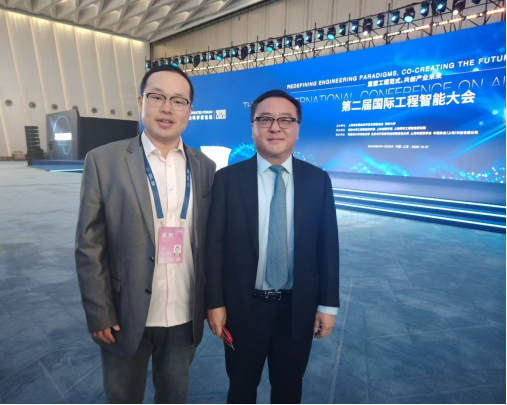
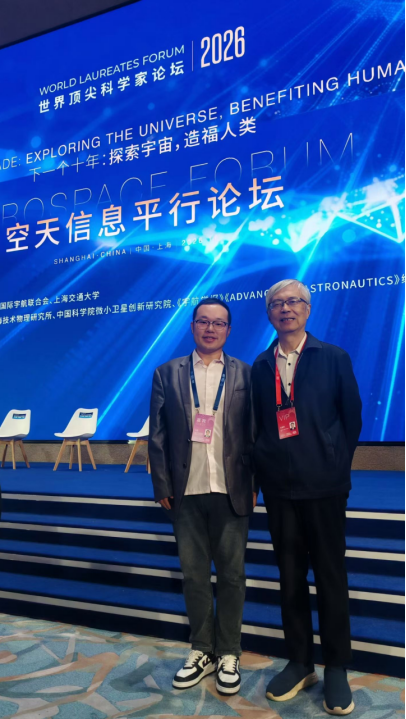
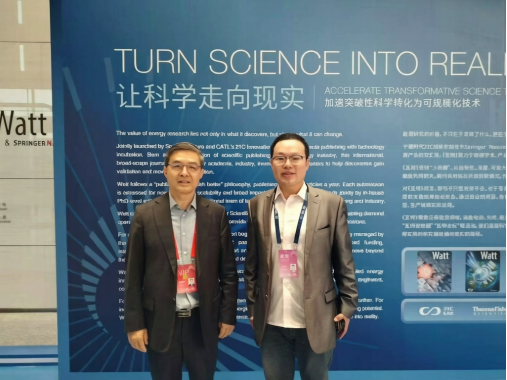
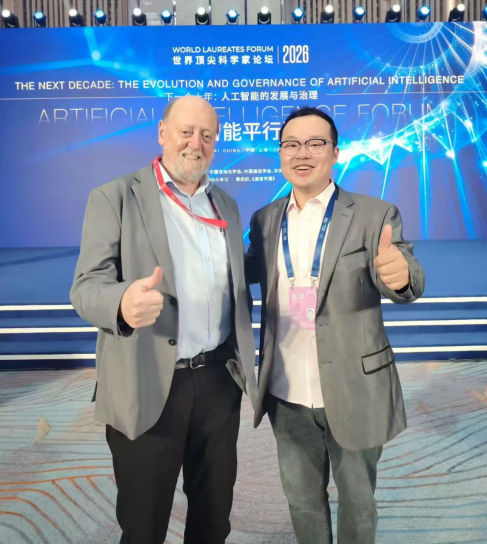
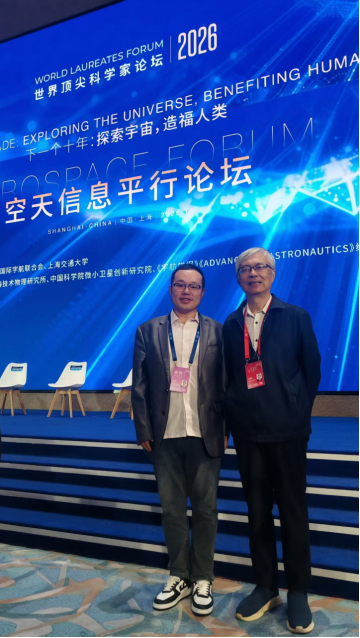
2026世界顶尖科学家论坛(WLF)于上海举办。谷沟智能Googleai副总裁、AI产业创新研究院院长、科创项目创始人、研究科学家、刘石(LIU SHI)博士受邀参加本次论坛。他同中国科学院外籍院士、欧洲科学院院长唐纳德·布鲁斯·丁韦尔,围绕人工智能相关议题开展交流;同时与2021年图灵奖得主杰克·唐加拉,国际知名计算机科学家、外籍院士诺加·阿隆(Noga Alon),中国科学院院士王建宇,英国萨里大学航天研究所杰出教授马丁·斯威廷,中国工程院院士欧阳明高,清华大学智能产业研究院院长、前微软亚洲研究院院长、中国工程院外籍院士、IEEE会士(IEEE Fellow)、美国艺术与科学院院士、澳大利亚国家工程院外籍院士、国际欧亚科学院院士、前百度集团总裁张亚勤等多位全球顶尖科学家开展沟通交流,并合影留念。
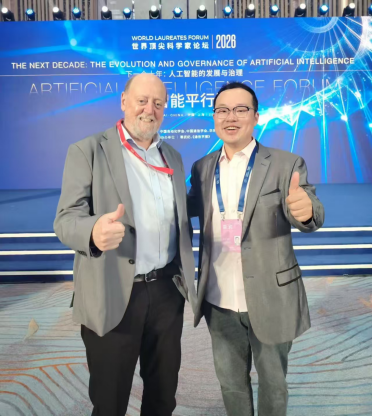
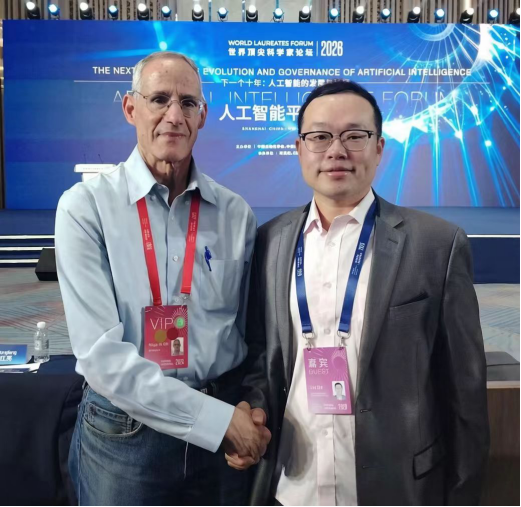
刘石与2021年图灵奖得主杰克·唐加拉 论坛期间,刘石发布年度AI产业科学论断,系统阐释全球人工智能从生成式大模型向“世界模型+物理空间智能体+多智能体协同”范式跃迁的底层逻辑,首次提出“物理多维空间Token”“世界模型七层架构”“物理图灵黑白盒测试”等原创框架,并对未来十年智能交通、智能汽车、无人机、低空经济、机器人、具身智能、新能源智能化的产业变革作出阶段性研判,为全球下一代人工智能世界模型的物理化落地提供前瞻判断与理论支撑。
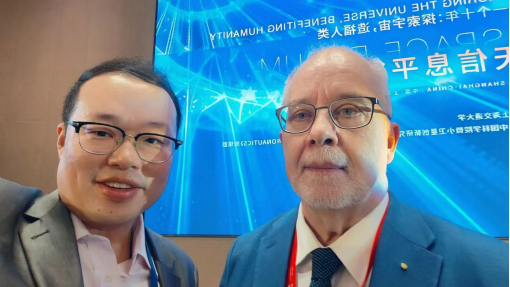
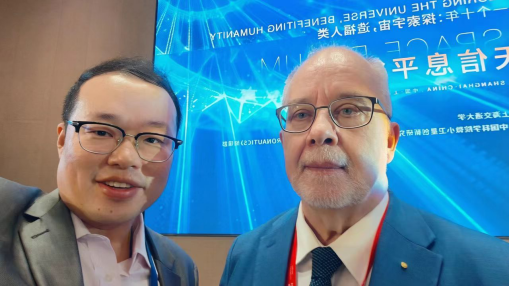
刘石与欧洲科学院院长唐纳德·布鲁斯·丁韦尔 一、范式跃迁:人工智能的第二次革命已经开始 过去三年,生成式人工智能解决的核心问题是“信息到信息的映射”:把文字变成文字,把描述变成图像,把问题变成答案。这一范式的成绩有目共睹,但它的边界同样清晰,语言与图像承载的是人类对世界的描述,而不是世界本身。 刘石给出一个凝练的判断:语言模型学会的是人类如何描述世界,世界模型要学会的是世界如何运转。物理世界有三个语言无法覆盖的特征:连续性(时间不可跳帧)、因果性(推演必须遵循物理约束)、不可逆性(错误无法撤回重采样)。这三条决定了,仅靠扩大语料与参数,无法让机器真正进入物理世界。 他因此提出,2026 年是全球 AI 的分水岭:第一范式的核心指标是内容生成质量,第二范式的核心指标是行动执行成功率。衡量一个模型是否先进,将不再看它写得像不像人,而看它在真实场景中连续完成复杂操作的成功率。围绕这一转变,刘石提出物理智能的五要素框架:可预测的世界模型、可验证的因果数据、可执行的智能体、可协同的智能体、可进化的具身智能。
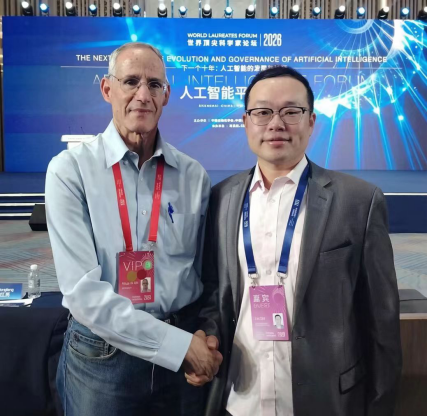
刘石与国际知名计算机科学家、外籍院士 Noga Alon 二、技术内核:世界模型的七层架构与物理多维空间 Token 为了让世界模型从概念变成可工程化的对象,刘石首次公开他和他的团队在世界模型领域掌握的核心技术七层世界模型架构。
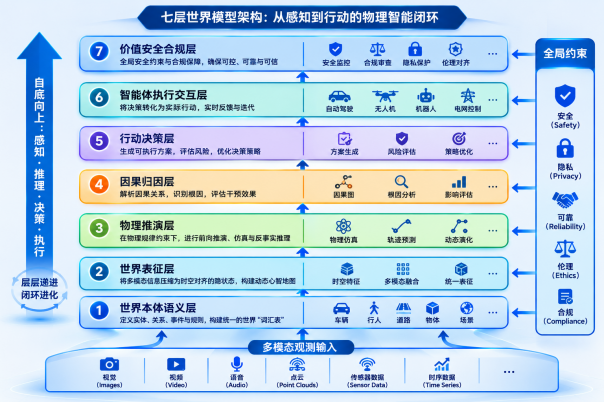
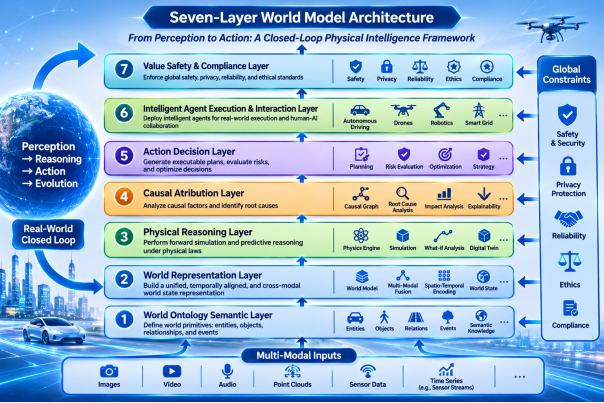
图1 七层世界模型架构:从感知到行动的物理智能闭环 七层世界模型是面向智慧交通、智能汽车自动驾驶、低空经济无人机、电网、机器人等高后果物理场景的机器心智栈,遵循从本体定义到跨模态表征、从物理推演到因果归因、从行动决策到智能体交互执行,再到价值安全约束的闭环;核心判据是:推演的物理一致性优先于像素逼真度,支持反事实干预、可解释、人机共裁决。 (一)世界本体语义层 负责构建机器可解释的世界原语体系,定义实体类别、拓扑关系、物理属性、事件谓词、角色与交互范式。不直接处理原始传感信号,而是建立一套稳定、可复用的世界词汇表:区分刚体、柔性体、流体;定义碰撞、打滑、遮挡、变道等事件;标注车辆、行人、路面、传感器、执行器等主体。原始图像、点云、力觉、音频、时序传感信号经由模态预处理、编解码、检测匹配,映射至该符号本体空间。 本层回答:机器用何种统一语义框架去描述世界? (二)世界表征层 在本体语义约束下,将视觉、点云、力觉、声音、时序传感信号压缩为时序对齐、跨模态耦合、可推演的隐状态,构建动态统一的心智地图。本层解决机器如何记住动态世界,而非仅仅识别孤立物体。核心突破是时空模态对齐:让模型感知到车轮打滑瞬间,扭矩、胎压、路面附着系数、车身姿态是同一事件的不同观测侧面。隐状态同时承载连续几何信息、离散本体标签与时变物理参数,作为后续推演的统一状态接口。 本层的关键技术难点是跨模态的时间对齐,而非特征融合。真实系统的传感器是异步、多速率的:相机30 Hz、激光雷达10 Hz、IMU 200 Hz、轮速与扭矩走总线、音频48 kHz。若只在特征层做晚期融合,打滑瞬间的因果顺序会被抹平。因此本层需要在统一时间栅格上重建同一时刻的概念,并把各通道的观测连同其时间不确定性一起编码进隐状态,使下游推演能够区分已知同时发生与推测同时发生。 本层的实现组件包括各模态的前端编码器、点云主干、音频前端、时序卷积或状态空间模型,以及用于压缩与重建的变分或扩散式编解码结构。这些组件属于本层内部的管线设计,其选择随算力与数据条件变化,因而不构成独立层级;本层评价指标为下游任务成功率、隐状态的预测充分性与对齐误差。 (三)物理推演层 在低维隐态空间内执行前向状态演化、扰动仿真与干预、反事实推演,显式嵌入守恒方程、接触动力学、摩擦本构、形变场、辐射传输、流体输运等物理先验约束。 刘石强调,本层是世界模型与视频生成模型的本质分界:视频生成范式以像素分布拟合、视觉观感逼真为优化目标;世界模型以物理一致性、干预后具身动作闭环成功率、状态演化误差为核心评价指标。推演模块输出带不确定性测度的多分支状态轨迹,对系统演化的多可能性进行显式建模。 本层在隐空间中执行“如果……会怎样”的反事实推演,并显式约束守恒律、接触约束、摩擦锥、材质形变与光照传播规律。其算子形式为 P: (z_t, a_{t:t+H}) → Δ(Z_{t+1:t+H}),输出为带不确定性的多分支状态分布,而非单一确定性轨迹。约束以投影或罚项的形式进入推演过程,例如质量与动量守恒的残差项、非穿透约束、接触力的互补条件,使推演在物理上可被检验。 这一层是世界模型与视频生成模型的真正分界线。视频生成追求“看起来对”,其评价标准是像素相似度与感知质量;世界模型追求“推演得对”,其评价标准是物理一致性指标(守恒残差、穿透率、接触力误差、能量漂移)与下游动作成功率。两者的差别不在于是否使用扩散模型,而在于损失函数里是否包含物理约束、评测集里是否包含干预实验。一个在画面上无可挑剔的生成模型,完全可能推演出违反摩擦锥的轨迹,而这在交通与电网场景中是不可接受的。 本层评价指标应至少包含三项:短时物理一致性、长时在线推演漂移(rollout)与干预条件下的成功率。三者缺一不可,因为短时一致但长时漂移的模型无法支撑规划,长时稳定但干预失效的模型无法支撑反事实推理。 (四)因果归因层 针对物理推演输出的多分支假想轨迹实施因果解耦,增量构建动态因果图,辨识可干预变量,量化区分相关性与因果驱动效应,定位异常事件的根因链路。 物理推演回答“系统将会演化至何种状态”;因果归因进一步回答“演化由哪些驱动因子主导,干预哪一变量可以重塑系统结局”。例如在车辆失稳推演中,可区分根因来自路面附着衰减、轮胎损耗、转向输入扰动、制动时延或是传感器偏差。输出结构化、可审计的因果因子集,是高后果场景可解释性的底层支撑。 (五)行动决策层 本层决定世界模型在高后果产业场景的落地可行性:低空交通、自动驾驶、能源电网等场景拒绝模型自主独裁,采用模型提议、人做裁决的人机协同范式。模型不输出唯一控制指令,而是输出候选方案集合、各方案风险概率分布、约束边界与推荐依据。因此本层的接口设计比算法精度更关键:方案必须可比较(同一组风险与收益口径)、可拒绝(人可选定次优方案而无需解释)、可追溯(每个方案能回溯到其所依赖的推演分支与归因结论)。缺少这三项,再高的成功率也无法转化为部署许可。 融合物理推演轨迹、因果归因结论、状态不确定性分布,生成多候选时序动作序列、长短周期规划方案、风险包络与硬安全约束,输出可追溯、可核验的决策证据链。 本层把推演的多分支结果、因果归因结论与不确定性分布,转化为动作序列、时序长短期计划、硬约束与风险边界,并输出结构化的决策依据。它的产物不是一个指令,而是一个候选方案集合 {π_k},每个方案附带风险上界、约束满足度、预期收益与可解释依据,供人或上层系统比较。 (六)智能体执行交互层 本层将高层决策方案映射为底层控制空间指令,下发至物理智能体平台(自动驾驶车辆、无人机集群、移动操作机器人、电网调控单元);同步采集真实世界执行后的新观测流,回灌至世界表征层,在线迭代更新心智地图,形成“感知—推演—决策—执行”持续闭环。 本层集成轨迹跟踪、控制律适配、执行器容错调度、人工接管触发、人机交互接口等功能;它在架构上严格区分隐空间内的虚拟推演仿真,与真实物理载体的落地执行、反馈校正,是世界模型从虚拟心智空间落地到真实物理世界的闭环枢纽。 本层评价指标为跟踪误差、闭环任务成功率、人工接管率与故障恢复时间。需要强调的是,接管率不是越低越好:在安全边界附近,及时接管优于强行自主。 (七)价值安全合规层 本层作为全局约束校验层,对本体定义、表征编码、物理推演、因果归因、决策规划、执行控制全链路实施边界拦截与一致性校验。内嵌形式化安全规约、行业法规约束、价值偏好函数、风险阈值判定、失效降级策略与兜底安全逻辑。 它并非后置简单过滤模块,而是具备前置约束能力:在本体定义阶段剔除非法事件范式;推演阶段截断高风险演化分支;决策阶段否决触碰安全红线的方案;执行阶段触发紧急兜底机制。保障整套世界模型始终运行在人类可接受的安全与价值可行域之内。 面向低空交通、自动驾驶与电网这类系统,本层还需承担预期功能安全(SOTIF)意义上的边界识别:明确哪些场景属于模型能力边界之外,并在进入这些场景前触发降级或接管。其评价指标为约束违反率、风险事件漏检率、降级触发正确率与拒绝理由的可读性。 在架构之外,刘石提出的另一个原创概念是“物理多维空间Token”。他指出,大模型的词汇表由词元构成,而物理世界需要自己的词汇表:位置、速度、加速度、力矩、摩擦系数、材质刚度、光照强度,都应当被量化为统一的离散单元,进入同一套可推理、可组合、可迁移的表示空间。有了物理多维空间Token,世界模型才第一次拥有了物理语法,才可能像语言模型做续写那样,做物理过程的续演。 他进一步给出对世界模型Scaling Law的修正:规模定律不只体现在参数与算力,更体现在“物理多样性”,即同一场景在不同光照、天气、材质、载重、磨损状态下的交互样本数量。这也解释了为什么单纯堆叠视频数据无法带来物理智能的跃升:视频记录的是世界的表象分布,而非因果分布。
刘石与张亚勤(前百度集团总裁、前微软亚洲研究院院长、清华大学智能产业研究院院长、中国工程院外籍院士、IEEE会士) 三、智慧交通:世界模型将成为路网的第二引擎 交通系统的智能化长期停留在感知与识别层面:看得见车、数得清人,但红绿灯配时、匝道控制、事故处置仍依赖人工经验与离线模型。刘石认为,这正是世界模型的第一个大规模落地场景。 他描述了推演型交通控制的运行方式:对全城路网做未来15至30分钟的滚动推演,每一个控制动作先回答“如果这样调,半小时后会发生什么”,再决定是否执行。这带来三个层面的改变:从“事后响应”转向“事前推演”,从“单点优化”转向“网络博弈”,从“人定规则”转向“模型提议、人做裁决”。 刘石给出的时间判断是:2027至2037年,中国头部城市的信号控制将从“规则+强化学习”升级为“世界模型推演+多智能体协同”,高峰时段通行效率有望提升15%至30%;2030年前后,城市级“交通世界模型”将成为与出行大数据、地图、气象并列的基础数据底座。智慧交通的天花板,从来不是摄像头数量,而是对未来的预见长度。 四、智能汽车:从感知驱动走向推演驱动 当前量产车的智能驾驶主体仍是端到端感知决策:看到什么,就怎么开。这一路径在常规工况下表现优异,却在遮挡、鬼探头、临时施工、极端天气等长尾场景中反复失手。刘石指出,原因不在于感知不够强,而在于系统缺少对没看见的部分进行推演的能力。世界模型补上的正是这一环:它可以在隐空间中预演被遮挡区域可能出现的物体、预演前方车辆的异常意图、预演雨雪条件下制动距离的漂移,从而把反应变成预测。在工程实现上,刘石主张云边端协同,云端训练大规模世界模型,通过蒸馏与稀疏化下沉到车端,实现毫秒级的本地物理端侧推演,既满足实时性,又节省大量算力,又避免对网络情况的绝对依赖。 他给出的产业节点颇具进取性:2037 年前后,“世界模型 + 端侧智能体”将成为自动驾驶车型的标准配置;2033 至 2037 年,限定城市的 L4 规模化运营将成为现实,单车智能硬件成本较 2026 年下降 50% 左右;2033 年,车路云一体化的推演闭环将成为主流架构。他的原话:“未来的汽车不是一台更聪明的车,而是一台会预演的车。” 五、低空经济:无人系统的成本拐点与空域智能 低空经济的核心难题从来不是能不能飞,而是如何让成千上万架飞行器在同一片空域里安全地飞。高密度、强扰动、强时变,使传统的人工审批与静态航线规划迅速触及上限。无人机智能质检等AI交叉科学的实际场景应用将成为低空经济增长的拐点。 刘石认为,世界模型在低空场景承担三项关键任务:微气象与风场推演,把城市峡谷中的阵风、热岛效应、楼宇尾流提前算出来;空域冲突概率推演,把可能相撞变成提前规避;集群意图预测,让编队中的每一架飞行器理解同伴下一步要做什么。 基于此,他预判 2037 年左右重点城市的低空物流航线将进入常态化运行;2037年前后,低空即时配送的单票成本有望降至地面同城配送的 70% 以下,届时低空经济才真正具备商业闭环;2057 年,低空空域管理将从人工审批转向模型推演+自动放行。他特别提醒产业界:低空经济的天花板不在飞行器性能,而在空域智能水平。
刘石与中国科学院院士王建宇 六、具身智能:机器人的仿真到真机的数据飞轮 机器人产业当前最大的瓶颈不是本体,而是数据:真机采集贵、慢、少,一个灵巧操作任务动辄需要数万条示教轨迹。刘石给出的解法是双向数据飞轮,即由世界模型生成高保真合成数据,在真机上执行验证,把失败样本回灌模型,再生成更贴近真实分布的下一批数据。飞轮转起来之后,数据成本将随规模递减,而不是递增。 他进一步预判产业分工的演化:2033 年,通用人形机器人将在3C装配、仓储分拣等半结构化场景实现世界模型物理AI千台级部署;2037 年,行业将分化为通用本体和专用技能包的供应格局,技能包可以像应用一样被分发、订阅与迭代;2032 年,“物理图灵黑白盒测试”将成为重要评测基准。 所谓物理图灵测试,是刘石提出的原创评价方法:让机器人在此前从未见过的真实场景中,连续完成上百类陌生操作任务,全程无人工干预,成功率超过99%,即视为通过。他强调,这一标准的价值不在于难度,而在于它把行业从演示视频竞赛拉回能力竞赛。我们不需要人为遥控、更会表演的机器人,而需要真正能解决问题的机器人,尤其是在人类无法作业、难以完成任务的极端与危险场景中。 七、新能源:从设备智能化到系统智能化 新能源的智能化上半场是设备级的:风机变桨、光伏跟踪、电池管理、充电桩调度,各自都很聪明。下半场是系统级的:源、网、荷、储如何作为一个整体实时平衡。刘石认为,这正是世界模型的天然战场。世界模型可以把“源—网—荷—储”变成可推演的整体:对风光出力做多时间尺度预测,对负荷曲线与电价信号做联合推演,对储能充放策略做反事实比较,对电网安全稳定边界做前瞻判断。相比传统时序预测模型,其优势在于能够处理从未发生过的组合,例如极端天气叠加高负荷叠加新能源大发,这类样本在历史数据中几乎不存在,却必须在推演中被预演。又如磷酸铁锂与固态电池的研发和应用,可将能量密度、安全可靠性与温度等因素结合起来开展深入预测与分析,这些对于电池厂商、智能硬件企业、新能源企业等都具重要价值。 他给出的路线是:2033年前后,电动汽车集群作为分布式可调资源参与电网调峰将进入规模化商用,车网互动(V2G)从示范走向常态;2033年,省级电网调度中的 AI 推演模块成为标准配置;2037年,能源互联网世界模型将支撑新型电力系统的实时平衡。他的判断是:“新能源的下一场革命不是装机量,而是能源互联网系统能力。”
刘石与清华大学教授、中国科学院院士欧阳明高合影 八、治理与协同:物理智能的三可安全边界 当模型开始直接驱动物理设备,安全的含义发生了变化。刘石提出物理智能的三可原则:可解释,即决策链条可被逐层拆解,而不是给出一个黑箱动作;可回溯,即每一帧推演可复现,事故调查有据可查;可接管,即人在关键节点必须能否决系统,且否决要即时生效。 他同时呼吁全球协同:物理智能的安全问题没有国界,建议由多国科研机构共同建立跨国物理智能安全基准与开源评测集,把治理的重心从事后追责前移到事前压测,并建议依照国家政策方向,更有效地推进协同与合作。 在谈到中国的角色时,刘石的判断相当明确:中国在智慧交通、低空经济、新能源三大场景上拥有全球最丰富的真实物理数据与最复杂的运行环境,这恰是世界模型时代最稀缺的战略资源。“世界模型的竞争,最终是物理世界和人才的丰富度之争。” 九、结语:世界模型物理智能的三个十年 最后,刘石把视野拉到更长的时间尺度。他把物理智能的演进划分为三个阶段。 第一个十年(2026—2035):世界模型成为基础设施,物理智能体进入规模化商用。这一阶段的决定性变化发生在技术栈底层:世界模型与三维重建正在合流,神经辐射场与 3D 高斯泼溅提供的可微场景表示,与隐空间动力学共用同一套状态,使可渲染与可推演第一次不再是两条割裂的技术路线;物理引擎走向可微化,守恒律、接触与摩擦以可微约束进入训练环节,仿真不再只是训练前的数据生成环节,而成为训练过程中的监督信号;真实数据、合成数据与闭环回放构成持续的数据循环,sim‑to‑real 的差距也从域随机化的工程技巧,转为可度量的迁移误差。在算力侧,蒸馏、量化与稀疏化把推演压进车规与机载芯片的功耗范围,十毫秒级闭环推演从实验室走向量产控制器。随之被改写的是评价体系:物理一致性基准、不确定性量化的保形预测(conformal prediction),以及面向预期功能安全的认证流程,共同构成可被监管的物理智能。商业模式也随之清晰,世界模型即服务、场景级仿真订阅、闭环评测与责任界定,成为低空经济、自动驾驶、工业机器人与电网调度共享的基础设施。 第二个十年(2036—2045):物理智能体从专用任务走向通用协作,人机关系被重新定义。技术主线由单体智能转向群体认知:车路云机异构集群共享同一套世界状态,分布式推演在通信时延与状态一致性之间求解,联邦世界模型让数据不出域而知识可以汇聚;单一模型跨具身迁移,使同一套物理常识在机械臂、无人机与移动平台之间复用,硬件差异被抽象为可学习的执行器参数,而非重新训练的理由。决策接口从指令下发变为目标协商:人不再逐条批准动作,而是设定风险偏好与价值排序,模型给出可比较的方案与可追溯的归因。标准与互操作在这一阶段真正落地,层间接口、世界状态交换协议与跨厂商评测基准,构成产业分工的前提条件。 第三个十年(2046—2055):物理智能与科学发现深度耦合。人工智能不再只是规律的计算工具,而是参与假说生成、实验设计与结果解释:与第一性原理求解器(分子动力学、计算流体力学、等离子体输运)耦合的生成式世界模型,可以在隐空间中枚举尚未合成的材料与尚未稳定的位形;自驱动实验室把推演结论直接翻译成实验队列,形成推演、合成、表征、修正的自治闭环;在磁约束聚变、电池界面反应、蛋白质自组装这类高维非平衡系统上,模型的价值不在于拟合曲线,而在于给出可被实验反驳的机制假设。深空与极端环境则成为下一块试验场:行星级数字孪生、在轨自主决策、深海与地下作业,都需要一个能在通信受限、样本稀缺条件下继续推演的世界模型。 他以一句话收束全场:上一次工业革命让机器替代肌肉,大语言模型让机器掌握符号;而世界模型,将让机器建立对真实世界的因果心智。前者重塑生产力,后者重构文明的运行方式。 其科技价值,在于把预测变成可交付的工程能力:从像素相似度走向物理一致性,从相关性走向干预效应,从离线拟合走向在线闭环;其商业价值,在于把这种能力封装为可计量、可认证、可保险的基础设施,交通、制造、能源、低空与应急体系的产业形态将随之重排。七层架构所定义的,正是这条从观测到本体、从表征到推演、从归因到共决、从执行到约束的完整链路。当机器第一次能够可靠地回答“如果这样做,世界会怎样?”,人类便获得了一种新的认知工具,它不替我们选择方向,但会让每一次选择,都在真实世界的因果结构上被预先检验。(余新江) Shi Liu: World Models Usher in a New Era of Physical Intelligence and Reshape the Landscape of Multiple Industries — A Technology-Industry Outlook from a Guest at the 2026 World Laureates Forum The 2026 World Laureates Forum (WLF) convened in Shanghai. Dr. Shi Liu (LIU SHI), Vice-President of Googleai, Dean of the AI Industry Innovation Research Institute, Initiator of Science-and-Technology Innovation Initiatives, and Research Scientist, was an invited participant at the forum. He held discussions on AI-related topics with Donald Bruce Dingwell, Foreign Member of the Chinese Academy of Sciences and President of the Academia Europaea. Liu also engaged in exchanges with numerous world-renowned scientists, including Jack Dongarra, laureate of the 2021 Turing Award; Noga Alon, distinguished computer scientist and foreign academician; Wang Jianyu, Member of the Chinese Academy of Sciences; Martin Sweeting, Distinguished Professor at the Surrey Space Centre, University of Surrey; Ouyang Minggao, Member of the Chinese Academy of Engineering; and Ya-Qin Zhang, Dean of the Institute for AI Industry Research (AIR) at Tsinghua University, former President of Microsoft Research Asia, Foreign Member of the Chinese Academy of Engineering, IEEE Fellow, Member of the American Academy of Arts and Sciences, Foreign Member of the Australian Academy of Technological Sciences and Engineering, Academician of the International Eurasian Academy of Sciences, and former President of Baidu Group. Commemorative photos were taken during these interactions.
Shi Liu with Jack Dongarra, laureate of the 2021 Turing Award During the forum, Liu presented his annual scientific assessment of the AI industry, setting out the underlying logic of the global shift of artificial intelligence from generative large models to a paradigm of “world models + physical-space agents + multi-agent collaboration.” He introduced for the first time original frameworks including “physical multi-dimensional space tokens,” the “seven-layer architecture of world models” and the “physical Turing black-box/white-box test,” and offered stage-by-stage projections for the industrial transformation of smart transportation, intelligent vehicles, unmanned aircraft, the low-altitude economy, robotics, embodied intelligence and new-energy intelligence over the next decade—forward-looking judgments and theoretical support for the physical-world deployment of the next generation of global AI world models.
Shi Liu with Donald Bruce Dingwell, President of the Academia Europaea 1. Paradigm Shift: the Second Revolution of Artificial Intelligence Has Begun Over the past three years, generative artificial intelligence has solved a core problem of “information-to-information mapping”: turning text into text, descriptions into images and questions into answers. The results of this paradigm are plain to see, but its limits are equally clear—language and images carry humanity’s description of the world, not the world itself. Liu offers a compact judgment: language models learn how humans describe the world; world models must learn how the world works. The physical world has three properties that language cannot capture: continuity (time cannot skip frames), causality (inference must obey physical constraints) and irreversibility (errors cannot be undone by resampling). These three properties mean that no expansion of corpora or parameters alone can bring machines into the physical world. He therefore argues that 2026 is the dividing line for global AI: the core metric of the first paradigm is the quality of generated content, while the core metric of the second is the success rate of executed action. Whether a model is advanced will no longer be judged by how human its prose sounds, but by how reliably it completes complex operations in sequence in real settings. Around this shift, Liu proposes a five-element framework for physical intelligence: a predictable world model, verifiable causal data, executable agents, collaborative agents and evolvable embodied intelligence.
Shi Liu with Noga Alon, a leading computer scientist and foreign academician 2. The Technical Core: the Seven-Layer World Model Architecture and Physical Multi-Dimensional Space Tokens To make the world model an engineerable object rather than a concept, Liu for the first time disclosed the seven-layer world model architecture—the core technology that he and his team have developed in this field.
Figure 1 Seven-Layer World-Model Architecture: Closed-Loop Physical Intelligence The seven-layer world model is a machine-cognition stack for high-consequence physical settings: smart transportation, autonomous driving of intelligent vehicles, UAVs in the low-altitude economy, power grids and robotics. It runs as a closed loop from ontology definition to cross-modal representation, from physical inference to causal attribution, from action decision to agent interaction and execution, and finally to value and safety constraints. Its core criterion: physical consistency of inference outranks pixel realism; it supports counterfactual intervention, explainability and joint human-machine adjudication. 2.1 World Ontology and Semantics Layer This layer builds a machine-interpretable system of world primitives, defining entity classes, topological relations, physical attributes, event predicates, roles and interaction paradigms. It does not handle raw sensor signals directly; it establishes a stable, reusable world vocabulary: rigid, deformable and fluid bodies; events such as collision, skidding, occlusion and lane changing; actors such as vehicles, pedestrians, road surfaces, sensors and actuators. Raw images, point clouds, force sensing, audio and time-series signals are mapped into this symbolic ontology space through modality preprocessing, encoding and decoding, and detection matching. The layer answers one question: within what unified semantic framework does a machine describe the world? 2.2 World Representation Layer Constrained by the ontology semantics, this layer compresses visual, point-cloud, force, audio and time-series signals into temporally aligned, cross-modally coupled and inferable latent states, and builds a dynamic, unified mental map. It addresses how a machine remembers a dynamic world, not merely how it recognizes isolated objects. The core breakthrough is spatiotemporal modality alignment: at the instant a wheel skids, torque, tire pressure, road adhesion and body attitude are different observational facets of the same event. Latent states carry continuous geometry, discrete ontology labels and time-varying physical parameters at once, and serve as the unified state interface for later inference. The hard problem here is cross-modal temporal alignment, not feature fusion. Real sensor suites are asynchronous and run at different rates: cameras at 30 Hz, LiDAR at 10 Hz, IMUs at 200 Hz, wheel speed and torque over the vehicle bus, audio at 48 kHz. Late fusion at the feature level alone would flatten the causal ordering at the instant of a skid. This layer must therefore reconstruct the concept of the same instant on a unified time grid and encode each channel’s observations together with their temporal uncertainty into the latent state, so that downstream inference can separate known simultaneity from inferred simultaneity. Implementation components include front-end encoders for each modality, a point-cloud backbone, an audio front end, temporal convolution or state-space models, and variational or diffusion-based codecs for compression and reconstruction. These are pipeline choices internal to the layer; they vary with compute and data conditions and do not constitute a separate tier. Metrics for this layer are downstream task success rate, predictive sufficiency of the latent state, and alignment error. 2.3 Physical Inference Layer This layer runs forward state evolution, perturbation simulation and intervention, and counterfactual inference in a low-dimensional latent space, embedding explicit physical priors: conservation equations, contact dynamics, friction constitutive laws, deformation fields, radiative transfer and fluid transport. Liu stresses that this layer is where world models and video generation models part ways: video generation optimizes for fitting pixel distributions and visual realism, whereas a world model is judged by physical consistency, closed-loop success of embodied action after intervention, and state-evolution error. The inference module outputs multi-branch state trajectories with uncertainty measures, explicitly modelling how many ways a system may evolve. In latent space the layer runs “what if” counterfactuals and explicitly constrains conservation laws, contact constraints, friction cones, material deformation and light propagation. Its operator form is P: (z_t, a_{t:t+H}) → Δ(Z_{t+1:t+H}); its output is a multi-branch state distribution with uncertainty, not a single deterministic trajectory. Constraints enter as projections or penalty terms—residuals for mass and momentum conservation, non-penetration conditions, complementarity conditions on contact forces—so that the inference can be checked against physics. This layer is the real boundary between the two paradigms. Video generation wants to look right and is scored on pixel similarity and perceptual quality; a world model wants to infer right and is scored on physical consistency (conservation residuals, penetration rate, contact-force error, energy drift) and downstream action success. The difference is not whether diffusion models are used, but whether the loss function contains physical constraints and whether the test set contains intervention experiments. A generator that is flawless on screen can still infer a trajectory that violates the friction cone—unacceptable in transportation or on the grid. At minimum, three metrics belong here: short-horizon physical consistency, long-horizon rollout drift, and success rate under intervention. All three are necessary: a model that is consistent briefly but drifts over time cannot support planning, and one that stays stable but fails under intervention cannot support counterfactual reasoning. 2.4 Causal Attribution Layer This layer disentangles the multi-branch hypothetical trajectories produced by physical inference, incrementally builds a dynamic causal graph, identifies intervenable variables, separates correlation from causal effect, and locates the root-cause chain behind anomalous events. Physical inference answers what state the system will reach; causal attribution answers which drivers dominate that evolution and which variable, if intervened on, would reshape the outcome. In a vehicle-instability case it can distinguish root causes among declining road adhesion, tire wear, steering input disturbance, braking delay or sensor bias. A structured, auditable set of causal factors is the foundation of explainability in high-consequence settings. 2.5 Action Decision Layer This layer decides whether a world model can actually be deployed in a high-consequence industry. Low-altitude transport, autonomous driving and power grids rule out letting a model act on its own authority; they use a human-machine pattern in which the model proposes and people adjudicate. The model issues no single control command but a set of candidate plans with risk probability distributions, constraint boundaries and grounds for recommendation. Interface design therefore matters more than algorithmic precision: plans must be comparable (same risk and benefit accounting), rejectable (a person may choose a suboptimal plan without justification) and traceable (each plan traces back to the inference branches and attribution findings it rests on). Without those three, even a high success rate cannot become a deployment permit. Fusing inference trajectories, causal findings and uncertainty distributions, the layer produces candidate temporal action sequences, long- and short-horizon plans, risk envelopes and hard safety constraints, and outputs a traceable, verifiable chain of decision evidence. It converts multi-branch inference results, causal attribution and uncertainty distributions into action sequences, temporal plans, hard constraints and risk boundaries, with a structured decision basis. The output is not a command but a candidate set {π_k}, each plan carrying a risk upper bound, constraint satisfaction, expected benefit and explainable grounds for people or higher-level systems to compare. 2.6 Agent Execution and Interaction Layer This layer maps high-level plans into low-level control-space commands and dispatches them to physical agent platforms—autonomous vehicles, UAV swarms, mobile manipulators, grid control units. It simultaneously collects new observation streams from real-world execution and feeds them back to the world representation layer, updating the mental map online and closing a continuous perception–inference–decision–execution loop. The layer integrates trajectory tracking, control-law adaptation, fault-tolerant actuator scheduling, manual-takeover triggering and human-machine interfaces. Architecturally it separates virtual inference in latent space from real deployment, execution and feedback correction on physical carriers; it is the hinge that takes a world model from virtual mental space into the physical world. Metrics are tracking error, closed-loop task success rate, manual takeover rate and fault recovery time. A lower takeover rate is not automatically better: near safety boundaries, timely takeover beats forced autonomy. 2.7 Value, Safety and Compliance Layer As a global verification layer, it intercepts and checks boundaries and consistency across the whole chain: ontology definition, representation encoding, physical inference, causal attribution, decision planning and execution control. It embeds formalized safety specifications, industry regulatory constraints, value preference functions, risk thresholds, failure degradation strategies and fallback safety logic. It is no post-hoc filter bolted on at the end; it constrains ex ante. Illegal event paradigms are removed at ontology definition; high-risk evolution branches are truncated during inference; plans that cross a safety red line are vetoed at decision; emergency fallback fires at execution. The whole world model thus stays inside a safety and value-feasible domain that society can accept. For low-altitude transport, autonomous driving and power grids, the layer also has to identify boundaries in the sense of Safety of the Intended Functionality (SOTIF): it must state which scenarios lie outside the model’s competence and trigger degradation or takeover before entering them. Metrics are constraint violation rate, missed detection rate of risk events, correctness of degradation triggering and readability of refusal rationales. Outside the architecture, Liu’s other original concept is the “physical multi-dimensional space token.” A large model’s vocabulary is made of tokens, he notes, and the physical world needs a vocabulary of its own: position, velocity, acceleration, torque, friction coefficient, material stiffness and illumination should all be quantized into unified discrete units within one representation space that can be reasoned over, composed and transferred. With physical multi-dimensional space tokens, a world model has a physical grammar for the first time—it can continue a physical process the way a language model continues a text. He then amends the scaling law for world models: scale shows up not only in parameters and compute but above all in “physical diversity”—the number of interaction samples of one scenario under different lighting, weather, materials, loads and wear. That explains why stacking video data does not produce a leap in physical intelligence: video records the surface distribution of the world, not its causal distribution.
Shi Liu with Zhang Yaqin, former President of Baidu Group, former President of Microsoft Research Asia, Dean of the Institute for AI Industry Research at Tsinghua University, Foreign Member of the Chinese Academy of Engineering and IEEE Fellow 3. Smart Transportation: World Models as the Road Network’s Second Engine Transport intelligence has long stopped at perception and recognition: vehicles are seen, people are counted, but signal timing, ramp control and incident handling still rest on human experience and offline models. Liu sees this as the first large-scale landing ground for world models. He describes how inference-based traffic control would run: rolling 15-to-30-minute inference over the city’s road network, with every control action first answering “if we adjust this way, what happens in half an hour?” before anything is executed. Three shifts follow: from after-the-fact response to ahead-of-time inference, from single-point optimization to network game, from rules set by people to “model proposes, people adjudicate.” His timeline: between 2027 and 2037, signal control in China’s leading cities will move from “rules plus reinforcement learning” to “world-model inference plus multi-agent collaboration,” lifting peak-hour throughput by 15 to 30 percent; around 2030, a city-level “transportation world model” will stand beside mobility big data, maps and meteorology as a foundational data layer. The ceiling of smart transportation was never the number of cameras, but how far ahead it can see. 4. Intelligent Vehicles: from Perception-Driven to Inference-Driven Intelligent driving in today’s production cars is still end-to-end perception and decision: drive as you see. That path does well in ordinary conditions and fails repeatedly in long-tail ones—occlusion, a pedestrian emerging from behind cover, temporary roadworks, extreme weather. The cause, Liu argues, is not weak perception but the absence of any ability to infer what is not seen. The world model supplies exactly that: in latent space it rehearses objects that may appear in an occluded area, abnormal intent of the car ahead, the drift of braking distance in rain or snow—turning reaction into prediction. In engineering terms he advocates device–cloud–edge coordination: large world models are trained in the cloud and distilled and sparsified onto the vehicle, giving millisecond-level on-board physical inference that is real-time, saves compute and does not depend absolutely on connectivity. His industry milestones are distinctly assertive: around 2037, “world model + on-device agent” becomes standard on autonomous models; from 2033 to 2037, scaled L4 operation in designated cities becomes real, with per-vehicle intelligent hardware cost about 50 percent below 2026; by 2033, the vehicle–road–cloud inference loop becomes the mainstream architecture. His words: “The car of the future is not a smarter car; it is a car that rehearses.” 5. The Low-Altitude Economy: the Cost Inflection Point and Airspace Intelligence The hard question for the low-altitude economy was never whether aircraft can fly, but how tens of thousands of them share one airspace safely. High density, strong disturbance and rapid change push manual approval and static route planning to their limits. Practical AI cross-disciplinary applications at low altitude—drone-based intelligent inspection, for instance—will mark the inflection point for growth. Liu assigns world models three tasks at low altitude: micro-meteorology and wind-field inference, computing in advance the gusts in urban canyons, heat-island effects and building wakes; airspace conflict-probability inference, turning possible collisions into pre-emptive avoidance; and swarm intent prediction, so every aircraft in a formation understands what its neighbours will do next. On that basis he projects that around 2037 low-altitude logistics routes in key cities will run in regular service; that around 2037 the cost per parcel of low-altitude instant delivery will fall below 70 percent of same-city ground delivery, the point at which the business case closes; and that by 2057 low-altitude airspace management will move from manual approval to model inference plus automatic clearance. His caution to industry: the ceiling of the low-altitude economy is not aircraft performance but the intelligence of the airspace.
Shi Liu with Wang Jianyu, Academician of the Chinese Academy of Sciences 6. Embodied Intelligence: a Data Flywheel from Simulation to Real Machines The bottleneck in robotics is data, not hardware: real-robot collection is costly, slow and sparse, and one dexterous manipulation task can demand tens of thousands of demonstration trajectories. Liu’s answer is a two-way data flywheel: the world model generates high-fidelity synthetic data, which is executed and validated on real machines; failure samples go back into the model, which generates the next batch closer to the real distribution. Once the flywheel turns, data cost falls with scale instead of rising. He goes on to project how the division of labour evolves: by 2033, general humanoid robots will reach thousand-unit deployment of world-model physical AI in semi-structured settings such as 3C assembly and warehouse sorting; by 2037, the industry splits into general bodies and specialized skill packages, with skills distributed, subscribed to and iterated like apps; by 2032, the “physical Turing black-box/white-box test” will be a major benchmark. The physical Turing test, Liu’s own eva luation method, places a robot in real scenes it has never encountered and requires it to complete more than a hundred unfamiliar manipulation tasks in sequence, unattended, with a success rate above 99 percent. Its value, he stresses, is not difficulty but that it pulls the industry from a contest of demo videos back to a contest of capability. We do not need teleoperated robots that perform better; we need robots that solve problems—above all in the extreme and dangerous settings where people cannot work. 7. New Energy: from Device Intelligence to System Intelligence The first half of new-energy intelligence was device-level: pitch control, photovoltaic tracking, battery management, charge-point scheduling—each clever on its own. The second half is system-level: how source, grid, load and storage balance in real time as one. That, Liu argues, is the natural battlefield for world models, which can make “source–grid–load–storage” an inferable whole: multi-timescale forecasting of wind and solar output, joint inference of load curves and price signals, counterfactual comparison of storage charge–discharge strategies, forward judgment of stability boundaries. Against conventional time-series forecasters, the advantage is handling combinations that have never happened—extreme weather stacked on high load stacked on a surge of renewables—samples that barely exist in history yet must be rehearsed. The same applies to lithium iron phosphate (LFP) and solid-state battery R&D, where energy density, safety and reliability, and temperature can be analysed together in depth, of real value to cell makers, smart-hardware firms and new-energy companies. His route: around 2033, electric-vehicle fleets as distributed adjustable resources in grid peak shaving reach scaled commercial use, and vehicle-to-grid (V2G) moves from pilot to routine; by 2033, AI inference modules are standard in provincial grid dispatch; by 2037, an energy-internet world model underpins real-time balancing of the new power system. His judgment: “The next revolution in new energy is not installed capacity, but the system capability of the energy internet.”
Shi Liu with Ouyang Minggao, Professor at Tsinghua University and Academician of the Chinese Academy of Sciences 8. Governance and Collaboration: the “Three Able” Safety Boundary of Physical Intelligence Once models drive physical equipment directly, safety means something else. Liu proposes three properties for physical intelligence: explainable—the decision chain can be taken apart layer by layer rather than ending in a black-box action; traceable—every frame of inference is reproducible, so an investigation has evidence; takeover-able—people must be able to veto the system at critical moments, and the veto must take effect at once. He also calls for global coordination: the safety of physical intelligence has no borders. He proposes that research institutions in several countries jointly establish cross-border physical-intelligence safety benchmarks and open-source eva luation sets, moving governance from after-the-fact accountability to before-the-fact stress testing, and that collaboration advance in line with national policy directions. On China’s role his view is plain: in smart transportation, the low-altitude economy and new energy, China holds the world’s richest real physical data and its most complex operating environments—the scarcest strategic resource of the world-model era. “Competition in world models is, in the end, a contest over the richness of the physical world and of talent.” 9. Conclusion: Three Decades of Physical Intelligence Finally Liu stretches the horizon. He divides the evolution of physical intelligence into three stages. First decade (2026–2035): world models become infrastructure and physical agents enter scaled commercial use. The decisive change happens at the bottom of the stack. World models and 3D reconstruction converge: neural radiance fields and 3D Gaussian splatting provide differentiable scene representations that share one state with latent dynamics, so that renderability and inferability stop being separate technical routes. Physics engines become differentiable, with conservation, contact and friction entering training as differentiable constraints, so simulation stops being only a pre-training data step and becomes a supervisory signal inside training. Real data, synthetic data and closed-loop replay form a continuous cycle, and the sim-to-real gap turns from a domain-randomization trick into a measurable transfer error. On the compute side, distillation, quantization and sparsification squeeze inference into the power envelope of automotive and airborne chips, taking ten-millisecond closed-loop inference from the lab to production controllers. The eva luation system is rewritten with it: physical-consistency benchmarks, conformal prediction for uncertainty, and certification for intended functional safety together make physical intelligence regulatable. Business models clarify: world-model-as-a-service, scenario-level simulation subscriptions, closed-loop eva luation and liability definition become infrastructure shared by the low-altitude economy, autonomous driving, industrial robotics and grid dispatch. Second decade (2036–2045): physical agents move from specialized tasks to general collaboration, and the human-machine relationship is redefined. The technical line shifts from individual to collective cognition: heterogeneous fleets of vehicles, roads, clouds and machines share one world state; distributed inference solves between communication latency and state consistency; federated world models keep data in place while knowledge converges; a single model transfers across embodiments, so the same physical common sense is reused across arms, drones and mobile platforms, and hardware differences become learnable actuator parameters rather than grounds for retraining. The decision interface moves from issuing commands to negotiating goals: people stop approving actions one by one and instead set risk preferences and value rankings, while models offer comparable plans with traceable attribution. Standards and interoperability finally land: inter-layer interfaces, world-state exchange protocols and cross-vendor benchmarks become the precondition for any division of labour. Third decade (2046–2055): physical intelligence couples deeply with scientific discovery. Artificial intelligence is no longer only a calculator of laws but takes part in hypothesis generation, experiment design and interpretation: generative world models coupled to first-principles solvers—molecular dynamics, computational fluid dynamics, plasma transport—can enumerate in latent space materials not yet synthesized and configurations not yet stabilized; self-driving laboratories turn inference into experimental queues, forming an autonomous loop of inference, synthesis, characterization and correction. In high-dimensional non-equilibrium systems—magnetic confinement fusion, battery interface reactions, protein self-assembly—the value of a model lies not in fitting curves but in offering mechanistic hypotheses that experiment can refute. Deep space and extreme environments become the next proving ground: planetary-scale digital twins, on-orbit autonomy, deep-sea and subterranean operations all need a world model that keeps inferring under constrained communication and scarce samples. He closes with one line: the last industrial revolution let machines replace muscle, large language models let machines master symbols, and world models will let machines build a causal mind about the real world. The first reshaped productivity; the last will restructure how civilization runs. Its technological value is turning prediction into an engineering capability that can be delivered: from pixel similarity to physical consistency, from correlation to intervention effect, from offline fitting to online closed loop. Its commercial value is packaging that capability as metered, certifiable and insurable infrastructure, which will rearrange transportation, manufacturing, energy, low-altitude operations and emergency response. What the seven-layer architecture defines is precisely that chain—observation to ontology, representation to inference, attribution to joint adjudication, execution to constraint. When a machine can for the first time reliably answer “if we do this, what happens to the world?”, humanity gains a new cognitive instrument: it does not choose our direction, but it pre-tests every choice against the causal structure of the real world.(Yu Xinjiang)
|
|||||||||||
 |
|||||||||||
| 推荐文章 |
| 图片主题 | ||||
|
|
||||
| 热门文章 |
| 最新文章 |
| 相关文章 |

|

|